


Tmun Tasting Experience


A visit to Tmun, as privileged as this might sound, is nothing new to us. This summer alone we visited twice; Tmun is quickly becoming one of my favourite restaurants for an evening where familiarity meets consistency meets flavours that sing to my soul.
I don’t remember having that wow moment with food when I was growing up; besides my mum's homegrown pesto Genovese and my nanna’s preparation of garlic-butter-fried Maltese rossi and her red sauce served on spaghetti with copious amounts of Parmiggiano — but besides these two staples nothing really stood out as gastronomic genius. I deeply fell in love with food when I started to cook for myself at age 9. And my go-to palate was Asian.
Ginger, garlic, coriander, sesame oil, soy sauce, any form of vegetable, something spicy, maybe some peanut butter, so many blocks of tofu and noodles; whenever possible udon. I could eat a combo of this variation for weeks on end. My parents had to endure it, later in my life Nina had to embrace that this would be her norm… and 15 years later, she’s still got to get onboard the Asian cuisine wagon; this time not my rendition but Tmun’s.
Pawlu Tmun; what a guy, I could hang out with him all day.
Chef Paul wears his heart on his sleeve and he cooks with the same show-all attitude. Whether it’s the style of his Sharing Menu (which I think is locally one of the best, if not the best structure to a menu for his type of restaurant), the way he presents a dish or the fact that even though this visit was our third of the summer (because October is still summer in Malta), I still managed to try three new dishes off his 7-course sharing menu.

Why 7-course, not 11-course; if I always say to go for the full experience? Simple. I wanted to taste things mindfully and not get bogged down by the fireworks of flavour by course 8. I wanted to focus on what I already knew was signature Tmun; discover something new and truth be told; I’ve now pretty much tasted everything Chef Paul has ever made—if we’re missing something I’ll see you next week Chef.
This visit I did not even order a dessert; instead I opted for a sweet chat with Paul outside the restaurant door; as he thanked new visitors for coming, and held long conversations or hugs with his repeat clients. Nothing could be sweeter.
But that’s enough rambling… time for the food.
Black garlic tartlet. Light, creamy, delicate crunch and a big black garlic flavour to start off your path towards that Asian profile.
Black garlic is iffy; it’s either over-used and dreary or just right and umami-forward enough to spark your palate; just as this did.

A bottle of 2025 Antonin Blanc, hailing from Marsovin’s Ramla Estate graced our table and carried us through the entire meal, where the delicate notes of vanilla and burnt toast play with the nuttiness of Paul’s menu alongside the crisp citrus and apple notes that ricochet with the aromatics and astringent tones of the Tmun menu.
Antonin Blanc is one of those white wines that the Maltese and Gozitan public should turn to for the bulk of the year; it’s easy to drink and not so heavy in MLF, with just enough oak to know you’re enjoying something delicious.
The nuttiness of the Antonin was further pronounced with our choice of Snack for the night, the lighter than air puri spheres filled with a cold lemon and stracciatella cream pani and topped with a gorgeously nutty Cantabrian anchovy.
This pani puri; a one-bite-wonder, kicked off the dining experience with an umami-forward celebration of fusion, that Chef Buttigieg works so gracefully under.
Keeping within the realm of fusion with what I think is Chef Paul’s signature ceviche, we moved on to a must-have on every visit.
This month’s version was lampuki ceviche, because seasonality matters.
The lampuki portions were treated: cured in some sort of magic that gave them a turgid texture, their thick cut perhaps meant to be segmented into two bites per portion but I went in full throttle; big lampuki chunk, that gorgeous pickled onion, texture-bringing corn nut and light (but oh so necessary) chilli sliver — balanced on your spoon with enough capacity to gather as much of the leche de tigre sauce as possible.
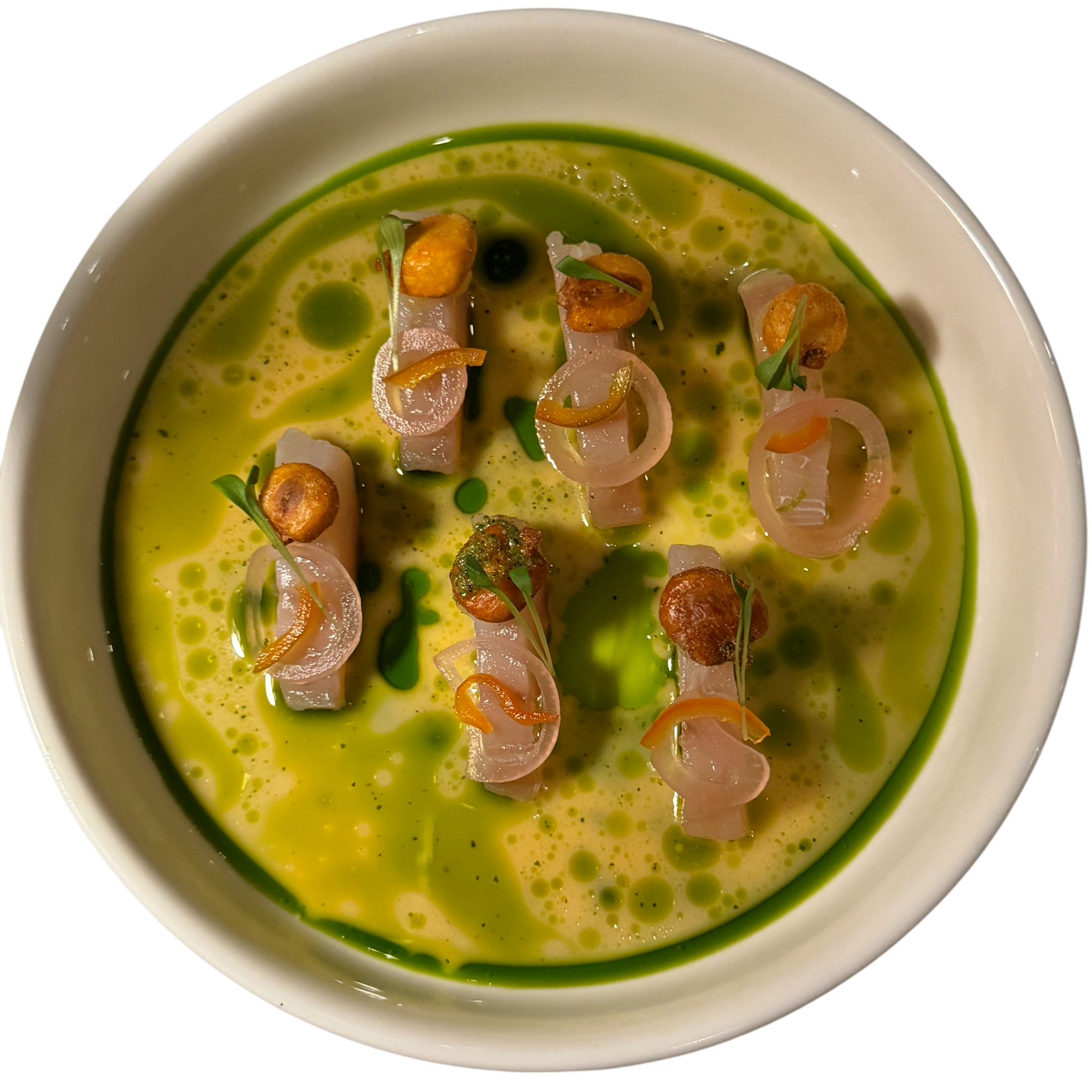
Leche de tigre. Oh. My. Gawd. It’s insatiable, we even joked that we needed an extra wine glass of just the leche de tigre, I could drink it by the bucket-load. It’s limey and acidic, it’s smooth and nutty, it’s tangy, it’s spicy, it’s savoury and it’s sweet with a herb oil creating tiger stripe patterns on the dish, on your spoon and in your heart.
Pairing with the delicate; and through Chef’s treatment, rather mild lampuka; this version was astounding. Visit 1 and 2 this summer featured tuna. We’ve also had a blue marlin version before.
They each deserved an award.
The following course was a first for us at Tmun. The fish soup. A bouliabaise-style in theory, but in my opinion a very good aljotta at heart, with the signature Chef Paul stamp of creativity, care and curation. That glottal burn that you get with aljotta was very much present here; you know that slight tingle at the back of your throat that makes you feel all the spice, aromatics and richness from the fish heads used to make such a wonderful dish.

This soup was thick, it was speckled with herb oil and it smelled like the sea and heaven had a lovechild; Poseidon and Hera’s fish soup of incestuous complexity that you can’t help but covet. A deep bowl arrives at your table, with three morsels at the base; hake, which seemed lightly battered, a chunk of Maltese red prawn, and a mussel. Teasing you with the aroma of a little jug, held in a caring hand, and poured gracefully beside the glistening rossa; notes of aniseed lifting off the plate as the hot pour very slightly splashed against its floating fishy friends.
Accompanying the fish soup, packed with aromatics and a marine saltiness you truly want in any fish-based dish, a very pretty ciabatta with a light saffron aioli.
Piped onto the bread face as though it were the most celebrated wedding cake of the century; trickled with edible flowers and almost too pretty to eat. If I were scoring dishes, this fish soup would get a 10/10; and folks I don’t really like fish soup.
It’s going to be hard to follow this dish, I thought.
Another new contender for us, the butternut squash risotto where texture means everything.

A sweet and delicate purée of butternut squash lined the entire plate for a smooth and graceful backdrop where texture was noted through the main ingredient: the very properly cooked risotto (I’m such a critic on risotto), accented by cubes of butternut squash, sautéed just enough to retain some bite, and a cascade of almond slivers and pumpkin seeds for little notes of nuttiness and of course a juxtaposition against the smooth risotto base.
A flow of Parmiggiano counteracted the sweetness; but perhaps a touch more saltiness would have taken this dish a bit further.
Delicious nonetheless; but in context of the entire meal, the butternut squash risotto needed some assistance in getting the task done.
Maybe a Parmigiano crisp or tuile could have helped her rank higher in the race.
Asian Calamari. I forgot what these guys looked like; I think the first time I had them was in 2024 but I never forgot what they tasted like.
The same overwhelming emotion engulfed me, where my ultimate flavour accents came to play: ginger, garlic, soy sauce, coriander, chili and honey. The flavours I would play with, the flavours my nanna loved (bar the coriander), this felt like home; but this time the tear that would generally trickle down my cheek turned into the most reassuring nod and smile.

Ordering calamari means I really trust you as a Chef. I think calamari more often than not are a failure in most restaurants. Either just boring oil-laden sponges or rubbery inedible rings from hell. Chef Paul, scores his calamari with a cross-hatch; and he scores in achieving the perfect texture by which the squid absorbs all the illustrious flavour of an aromatic bend that really hits the mark. These calamari are not spongy, not rubbery, not tough and not something you should miss.
The sauce in which they are smothered with is somewhat chewy, thanks to the honey I would presume, and the aroma seeps through the tender flesh that I would assume is very lightly cooked to retain the perfect texture. This, and the following dish are two that I would enjoy the bigger à la carte version of.
Let’s go straight to the next course; of which I really wanted a larger portion of, not because I was hungry, or because the sharing portion was small, but because gluttony should be my middle name. The panko tempura monkfish. Wowi wowi, traditional fish and chip shops should really learn a thing or two from this dish.
The tempura is light, not oily and oh my gosh, so damn good. There’s a light lemoniness to it; that might come from the delicately succulent fish encased within the batter or the tempura itself. The base of this dish is a hybrid between the most sumptuous marrow fat pea and the freshest petit pois side you’ve ever had.

The creamy segment added a luxurious element that I had to control myself with; this is a sharing plate, and Nina wanted some too; while the fresh peas pop in your mouth like a little tactile surprise. Thin strips of guanciale add saltiness, fattiness and a bit of porkiness to the already pretty darn perfect dish. I first had this dish in 2022, I think I would be happy to return to this dish till 2032 and beyond.
During one of our late summer visits this year, we’d run out of wine at this point in the menu, so I thought we’d spice things up with a Lord Chambray craft beer to get the full chippy experience. The coriander and orange peel notes of Lord Chambray’s Blue Lagoon cut through the fried fish’s attitude; but I’m surprised to say that the Antonin Blanc we were sporting during this visit offered a well-rounded balance and freshness that I found pleasant and quite complimentary.
The last fish dish of the evening, hake, as featured in the day’s catch. Shimeji mushrooms add a pickled, sweet note, with a linger of very light umami, the sugar snap peas are fun, both texturally and flavour-wise and the hake itself is gracefully prepared with a sweet overtone and a mild, clean balance.
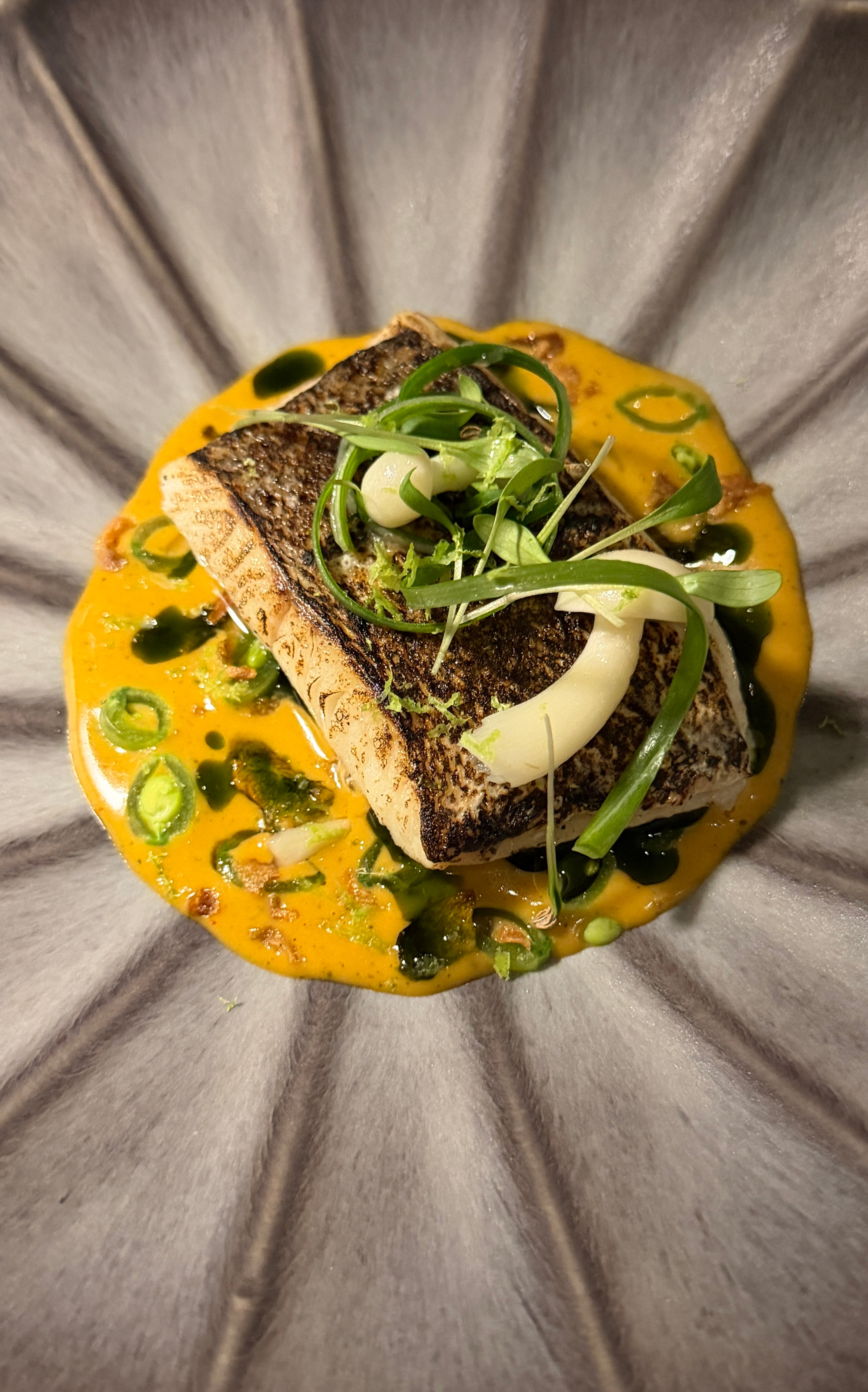
Cute. Very cute.
But the sauce takes this dish from cute to aggressively bold; and with its notes of lime and mastery of Asian fusion is very cleverly reminiscent of the addictive ceviche that you start your meal with.
Hats off Chef, I love a loop and return to memory.
The Thai flavours in this dish brought out a nice spice and coconut base that plays on the palate in a clever way.
Looking at the menu a bit deeper reveals that Chef Paul holds back on the spicy elements until the mains enter the picture.
Neither from the choices we selected, nor the glorious starters we sadly missed this visit, heavy spiciness is omitted; which I think makes sense based on the nature of his cuisine.
Spice can really numb your palate; the Thai curry presented here wasn’t overbearingly spicy, but tickled your tongue just enough.

The XO sauce on the final course was a touch spicier, but again, not so spicy that you can’t taste what you’re eating. I think extremely spicy dishes are silly. What’s the point in blowing your brains out with heat, numbing your palate and wiping your nose after every bite… I just don’t get it. I can really handle spice, I love an Indian vindaloo or a yellow Thai curry but, calm down now. I want to taste the actual protein too. Maybe this is just me; maybe it interrupts my tasting process.
Charlie’s XO is a nod to Paul’s travels, his constant seeking of new found skill, knowledge and opinion. He’s a traveller not only geographically, but also takes the time to travel within himself and find new answers. I respect this so much.
The XO here is fan-freakin’-tastic. Quite spicy, but not overpowering; and sat aside a delicious tzatziki to cool the palate and tie in the rare lamb chop dish as a cohesively fabulous end to our meal. As I said, we didn’t do dessert this time; but we left with a fragrant coriander and cumin taste that lingered alongside the gamey lamb and glossy, rich jus that dressed the plate.
I think I’ve said enough.
Imagine if we had the 11 courses, folks, you’d be here reading all night. Thank you Chef, thank you Tmun, thank you Gozo.


