


de Mondion Tasting Experience
- Kristina Cassar Dowling

- Dec 12, 2025
- 7 min read

When life’s memories are relived in slow-motion and you remember every detail, you know the imprinting was strong. There’s a difference in being impressed compared with being impacted by an experience. I think that being impressed is the result of effort, but being impacted is the result of passion.
I’ve been through the ‘impressed’ phase, and it’s nice to see variations of things I’ve already seen. I also understand that by the grace of Lakshmi, Hindu goddess of good living, I am exposed to a lot of impressionable food and drink; and boy am I grateful. But being impressed is not enough. I want impact so intense it moves me.
The de Mondion experience impacts so deeply it imprints on me.
The crackle of the fire greets you as first step into the rooftop restaurant, along with the impeccably gripping Front of House whose care and attention does not only limit itself to the menu and its sustainably sourced ingredients, but also the timing of service, the ricochet of conversation and their discrete ability to give you just a little bit more. It’s called the Xara touch and it’s captivating. A window-seat, the cosy view of bustling Malta in the distance and snacks.
First, a cone of texture and umami. The snap from the paper-thin ‘pastry’ and the fresh acidity of the Romesco hitting the salt from the 48-month-aged Salamancan Ibérico is dangerously good. Building up with the second tier of snacks, the gold-leaf topped Comté-filled sable featuring an apple gel. Even though this is a very texturally-forward dish, all I get (and I am damn happy about it) is butter. And knowing Executive Chef Clint Grech’s butter of choice, I am even damn happier. The entire thing melts with every chew.


This is where we reached for our champagne, knowing the toasty MLF tones will do a little happy dance with the cheesy bite that was sadly finished; leaving us with a glistening bauble of Xara Gardens beetroot glaze; a foie gras and rosemary essence presenting a sweet yet deeply savoury bite-sized tart to prepare the palate for the luxury to follow.
Use your last few sips of D. Florence Duchêne Champagne Brut Réserve to savour the Xwejni salt and pepper ħobża, freshly baked from a blend of Caputo “00” flour and wholegrain Greek flour for a nutty aroma intended to be devoured with either Xara olive oil or that good ol’ Brittany butter.
The next wine course in the Cellar Tour grew drier with every bite of food. A 2023 New Zealand Cloudy Bay with its passion fruit notes on both the nose and palate, compliments the most graceful ‘Tribute to the Mediterranean Sea’ featuring amberjack and prawn primarily, with three key dishes forming the tribute.
First, a Kombujime aged amberjack that was transformed both textually and flavour-wise. Let’s explain how. So… the technique of Kombujime intends to elevate the flavour of subtler-tasting white fish while creating a softer texture through the release of glutamates (amino-acids that accentuate umami) from the kelp. Erm… it worked. The texture of the amberjack is turgid, it feels cured and it’s packed with kombu flavour, not so much amberjack flavour.


The accompanying aljotta cappuccino was a reinvention of a traditional fish soup, carrying all the essence, but none of the form of the authentic version. The base of vegetable pearls, the sweet-salty-umami-bisque-like foam lathering every spoonful with what I am sure is a prawn head and butter heavy base. The prawn ring at the bottom got a little lost for me; it was delicious but it didn’t overload my senses texturally in this dish.
The compressed local red prawn, marinated and finished with micro-basil is nature’s simplicity at its best. Manipulated ever so slightly to highlight the sweetness and butteriness; every swirl on your tongue melting a little more. Chew prawns delicately… always.
The next course was complex and sophisticated. And the star was onion. Cévennes onion to be exact; chosen specifically for their sweetness. Prepared en papillote to trap all aroma in the parcel and prepared with Piemonte hazelnuts, a potato butter and Colonnata lardo. Here we are looking at a highly curated menu beaming with luxury ingredients chosen specifically for their particular textures and flavours.
This lardo is aged in Carrara marble, which means it lacks the usual wood-aged flavour we associate with ‘lardo’. Synonymous with hazelnuts, Piemonte is the only choice of origin when looking for that nutty aroma that plays so well with the salty fattiness of the lardo and the velvety and dense potato cream at the bottom of this dish. The star, as we already said, is the onion. Offering a sweet meatiness that only a master could bring out. Further accentuated with the sweet Riesling wine, a 2023 Schloss Johannisberg.
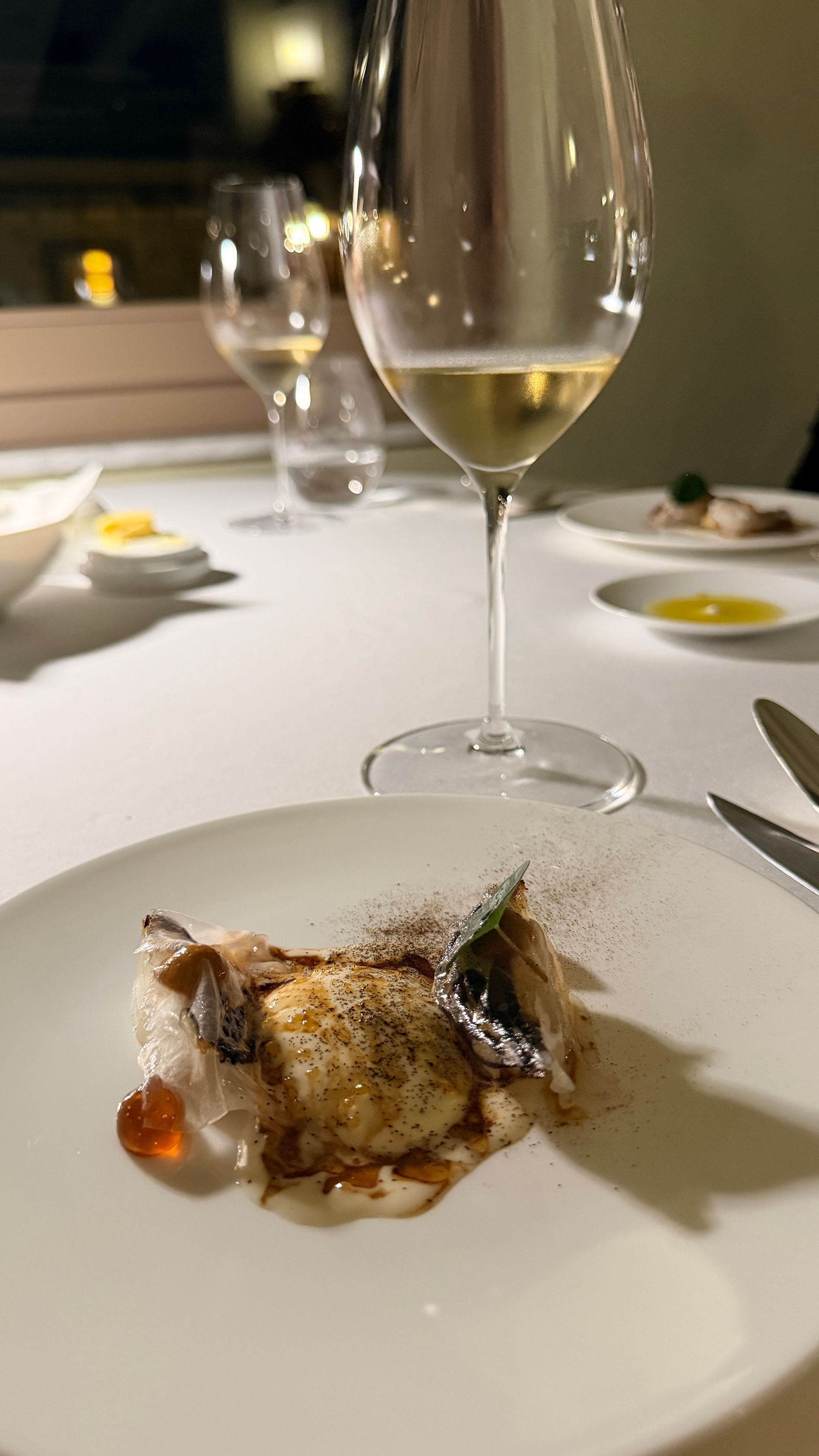

Following the Cellar Tour will take you to the only local insert on sommelier Miljan Radonjic’s list and an interesting one indeed. The 2021 Kiraż from neighbouring winemaker Markus Divinus carries a cranberry note with a slight oak—pairing well with the overall sensation of quick stop in Bologna via this dish. A mortadella agnolotti. Since we’ve already established that I do not particularly enjoy the taste of mortadella. Let’s look at the other elements of this dish.
This was my least favourite dish on the tasting menu tonight. While the Delectat Benedittin fondue was deliciously creamy and the meaty jus added such value in umami and depth of flavour; I felt that the pasta could have been thinner, the filling giving more of a pop of texture. I love truffles, adore them; but their flavour was not pronounced enough here, as generous as the shaving were.

The next dish however, presented a first for me. This was the first time that I genuinely cried in a restaurant. We have it caught on camera as proof. The next dish was entirely odd. Like, not the kind of side pairings you’d expect with the protein, and certainly not the dish to most stick with me… the fish dish.
Prepared a la plancha; the local line-caught seabass was absolutely perfect. Imma perfect! It broke on my fork like fish used to when it was good, it melted in my mouth like fish used to when it was good and it was oddly served with cauliflower and chanterelles like fish has never harmonised before apart from in the mind of the most elegant Chefs. Not that it’s an out of this world-pairing; but that it actually works so well.
The mushrooms were beyond words. I can’t even remember if it was acidity or just pure fireworks working their way through my tastebuds, knocking into each olfactory sensor like a pinball machine on overdrive in the 80s. The cauliflower, a buttery drape cascading around the glistening flesh of the tax-xewk moment fish.
This portion of fillet was treated right. I even asked Mirko Cocco if Chef sous-vide the fish before. “No, just a la plancha.” I promised myself I wouldn’t swear on bajtra. Feckin’ hell though… how did it cook so uniformly, with such a perfect skin; completely intact, glass-thin and majorly crispy. Every segment in the fillet broke off like pearls of perfection. This was an excellent fish dish, respected and treated in the most classical way. Paired with an MLF-forward 2021 Wildeberg White that carried a vanilla ice-cream note to my palate. Overall… delicious.
A welcome warmth surrounds our table, the roaring crackle and the aroma of bark under the seduction of the burning fire engages our senses; giving the experience an added level of impact. The aroma is further elevated with the hints of spiciness from the glass of Lyrarakis Karnarı Kotsifali. And to keep the sense of taste at the forefront; veal sweetbreads and peanut butter; with hints of pickled mustard and the now very noticed aroma, texture and flavour of truffle.
Texturally, this dish was entirely engaging. Sweetbreads have a particular texture in themselves, sometimes custardy, sometimes a bit subtler in flavour, sometimes rather rich. These were creamy and subtle. The overall flavour of this dish was peanut butter which is such a weird feature in such a restaurant. I thought it was excellent from concept to execution. What fun.


The last savoury course featured a tender pork cheek; paired with swede three ways, or so I counted. An extremely thin pickled version atop the side terrine of textural fantasy, a thicker butter-cooked version at the base and another simpler version, propping up the sweet-glazed pork cheek.
Reminding me of the Scottish dish: haggis, neeps and tatties; generally drenched in a luscious pepper sauce; hence the reference to this de Mondion dish, that in fact has no connection at all to the Scot pub classic, but memory still trickles in. The pepper sauce was insatiable, a little bit goes a long way, but I could have had a bucket of this kitchen’s version. Throughout the entire experience, and in this dish specifically, you get delightful pops of acid, a Chef Clint signature that helps cut the richness of his menus.
And just like magic, a new stomach opens up for dessert, because by golly you are at near-full capacity here. And magical it is, perhaps the most exciting pre-dessert for the senses.
“Pick your favourite colour”, asks Mirko. “OK”, nod we. And we choose a lilac and green glass spoon and wait a few minutes. A small white bowl, a thin gel encasing Chef Clint’s ‘Childhood Memories’. snap snap, snap. “Gasp”, say we. “Yeeees”, goes Mirko. It’s popping candy y’all. What kind of sensory sorcery is this?
Paired with honey, citrus, meringue and yoghurt, your favourite-coloured spoon digs to the bottom, crackle, crackle. You lift your spoon to your mouth, pop. And just like any kid in the 90s; you opened and closed your mouth, very unflatteringly, just to hear the crystalised sugar do its thing, feeling the candy pop on your tongue; echoing like the fireplace with every smile-filled bite. What a sensation!
A glass of Kopke 20-year Tawny later, we were presented with de Mondion’s version of Bernard Pacaud’s Tarte Ambroisie. Restaurant’s namesake, this dessert is special because it introduces a new technique to baking whereby a sabayone and ganache are folded together and baked inside a pâte brisée until a light crust forms. This is all chocolate by the way. And texturally, it’s like the pinnacle of a chocolate fondant outside, when it’s extremely good. After tasting this, I don’t think I can ever eat a fondant again; it’s not a big loss though honestly. This was moreish and luckily there was more-ish.
Just petit fours. But just is not allowed here. A scented sabayone was served alongside a blonde brioche and a teeny chocolate tart of wonder. With a glass of Henri Giraud Ratafia Champenois Solera to waddle home toastily, and a lavender-scented hand towel to wipe your sticky-brioche-hands.
I think I’ve said enough. Seeing is believing. I see you de Mondion.


