


Food on the Edge: the Malta Edition


By 2050, the expected number of people on this planet is estimated to reach 9.7 billion — all those people will need to eat. So the question that begs for an immediate solution is “what is the future of food?”
So broad, right? What a huge conversation. One that cannot be answered by a singular person or body, one that needs a huge discussion, intense reform and of course a dynamic solution.
Who better to ask than the Chefs and industry professionals around the globe?
Ireland-based symposium Food On The Edge was founded in 2015, with the scope of building a conversation around food, its sustainability and prevalence on our constantly impacted planet. When we say ‘sustainability’, we’re not talking about the buzz word that modern trendsetters use, just to jump on the bandwagon. We’re talking about the longevity of an industry, a population and a life source: the-forever-existence of food.
These guys bring together the best movers and shakers of the industry; stick them in one place for two days and allow them to discuss and share their visions on the future of food with the public. We’re talking about speakers like Rasmus Munk, Clare Smyth, Josh Niland, Claude Bosi, Massimo Bottura and quite frankly an encyclopedia of other Chefs with HUGE reputations.

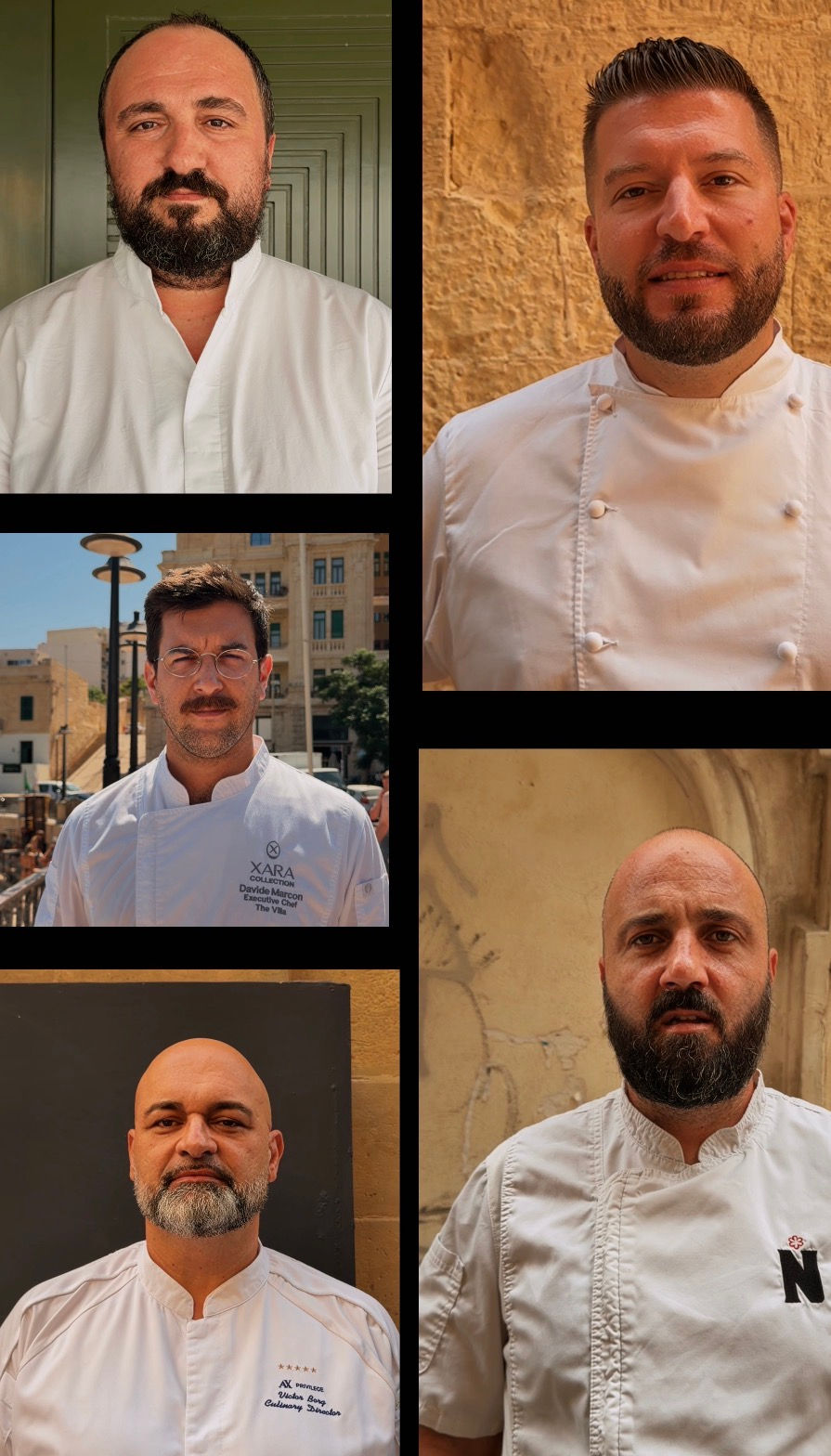
This October, 2026, Malta will be hosting Food On The Edge for its 11th edition in Valletta’s Fort St Elmo, where the crème de la crème of Malta’s Chefdom will share their insights on what the future of food is through their perspective. Here we’re talking about Chefs like:
Rosamí’s Davide Marcon,
NONI’s Jonathan Brincat,
Under Grain’s Victor Borg,
Le GV’s Andrew Borg,
de Mondion’s Clint Grech,
and other local influences in the industry; in and outside the kitchen.
We caught up with our local Chefs to pick their brains on a variety of topics; in anticipation for their big talks on the 19th and 20th of October. Not to overlap the conversation, but to delve a little deeper on what it means to preserve Maltese culinary heritage and identity as well as to understand our masters’ perspective on the future of food.
Malta’s Food on the Edge: A Cultural Shift
There is no denying that Malta’s food scene has shifted considerably. For de Mondion’s Clint Grech, the transformation of the last seven years has been particularly noticeable. “Maltese gastronomy has grown a lot,” he says. “Chefs became more ambitious. It’s not just about only serving good food anymore, it’s all about the experience.” He also points to a growing willingness to experiment with local ingredients, while admitting that Malta still lacks investment in “the young generation, education and respect.”
Andrew Borg of Le GV believes a stronger restaurant scene alone does not create a mature food culture. “We need much more education around food, cooking, ingredients and our own culinary culture,” he says. Malta needs to teach people “where food comes from, how to cook, how to recognise quality and why food and agriculture are such an important part of our culture.” He also points to the quality and availability of everyday ingredients, and the perception that some restaurants are an unnecessary splurge rather than an experience.
Under Grain’s Victor Borg believes Malta’s culinary identity and international recognition can “go hand in hand.” But he feels there is currently “a lot of the same” within Malta’s recognised food scene, particularly because so many celebrated Chefs operate in fine dining. His solution is refreshingly simple: “A bistro can carry a Michelin star; all it needs is really good food.” It does not have to be “foie gras, lobster and truffles”; “it could be tripe — but it has to be the best tripe you’ve ever had.”

Tradition: preserve it or reinvent it?
For Jonathan Brincat of NONI, there should be no rigid line between preservation and evolution. “No one gets to decide where we have lines in our kitchens,” he says. Preserving Maltese food is the responsibility of “chefs, home cooks, farmers, everyone.” As he sees it, “adapting and improving go hand in hand. Preservation is an improvement as well.”
Sometimes, however, the best interpretation is to respect something exactly as it is. “Let’s take timpana as an example.
It’s such an underrepresented dish.” For him, it holds that memory of “Sunday lunch after the festa at [his] grandma’s house: but it’s so good as it is, you have to do something really spectacular to do it justice… if you are going to transform it.”
Rosamì’s Davide Marcon also approaches tradition through memory. “The goal is to give you a vibe and memory and feeling of something traditional in another way,” he says. His reinterpretation of bigilla demonstrates his thinking: a dish can be texturally different, without tasting like traditional bigilla, yet still create “a little connection” that triggers a memory.
Teaching the next generation
The future, however, depends on who comes next. Marcon believes young chefs need a clear ambition to work towards. “In my journey as a Chef, there was a metaphoric carrot pushing me to achieve more,” he says.
Victor Borg takes a more traditional approach: “Younger generations need to put their heads down and work hard, get a mentor and listen.” First come the fundamentals; only then should young chefs “eventually branch out into their own interpretations.” For Borg, “a great chef is recognised by their understanding of the ingredients, the seasons and a great palate.”
Brincat brings it back to passion. “Now, everything is a scroll and a ten second reel,” he says. “Working as a Chef is not just another job. It’s a build up of so many things like investment, sacrifice and determination. But let’s boil it all down to passion for the craft.” After 25 years in the industry, his own conclusion remains simple: “I still have passion.”
Grech believes technical skills alone are not enough. “Recipes and techniques can be learnt from a video but taste cannot.” Young chefs need exposure to different kitchens and, most importantly, need to learn “how to think before they act.”

Food is ultimately about people
There is another constant beneath all this talk of technique, identity and innovation.
According to Andrew Borg, diners may now be more knowledgeable about food, ingredients and culinary cultures, but what they want has not fundamentally changed.
“People are still looking for an experience,” he says. “They want to be surprised, inspired and ultimately, to leave with a memory.”
And perhaps that is the most appropriate place to leave the question of the future of food. Because beneath the technology, sustainability, technique and innovation, food remains deeply human.
It is about what we inherit, what we change, what we teach and ultimately, what we remember.
With Victor’s advice to “have a mentor and learn the foundations first”, Davide’s motivation to “have something ahead of you that keeps pushing you forward,” Jonathan inspiration to “keep the passion alive”, Clint’s reminder to “teach young chefs to taste and think” and Andrew’s focus that “the ingredient must remain the protagonist,” the future of food is in safe hand from a Maltese heritage perspective.

